


Iran: Eyes on the Prize
Updated: Mar 29
Part One: Imperialism's war aims and quandaries
The Grand Old Duke of York, he had ten thousand men,
He marched them up to the top of the hill and marched them down again,
And when he was up, he was up, and when he was down he was down,
But when he was only halfway up, he was neither up nor down.
Britain is not officially at war with Iran. Starmer says he does not believe in regime change from the skies. Nevertheless, he condemns Iran’s retaliation as wreckless. He questions the unclear objecives of the war but does not condemn it as illegal. As the grim and boastful brutality of Operation Epic Fury terrorises Tehran and Beirut, Starmer has authorised the use of UK air bases, UK bombers and UK army personnel for so-called defensive purposes. But he will not accede to Trump’s demand for a war fleet in the Strait of Hormuz.
As the war staggers on into its fifth week, causing chaos in global gas and oil markets, Trump also finds himself in a quandary. The war aims of US imperialism have not only not been achieved, but they look further away than before. Trump is faced with an impossible situation. If he cuts his losses and declares victory now. that would represent a massive humiliation for US imperialism, and a huge personal blow. But any attempt to escalate would be fraught with danger and carry serious risks with only a slim chance of success. At the present time he appears as if he is attempting to do both at the same time.
Starmer's prevarication has unquestionably added to this quandary and is one more symptom of the new world disorder provoked by Trump in the first 3 months of his administration. The divergence over Ukraine, his opening shots in a global trade war and the threat to take over Greenland, have since been codified institutionally with the UK refusing to be part of Trump’s so-called Board of Peace. Washington's junior partner is getting uppity and is in a bit of a spin himself.
In its scramble to breathe life back into American industrial power, the White House is trampling upon virtually every multilateral institution of imperialist rule established in the aftermath of World War II. In this increasingly fragmented economic and military disorder, British imperialism finds itself buffeted by its shock waves and being evermore marginalised.
Britain’s Churchillian grandeur, which Trump demagogically invokes as a precedent for the “special relationship”, has long been a fake,. All the more so with regard to WWII when Rosevelt unceremoniously elbowed Churchill aside in both Iran and Saudi Arabia.[1]
As the grizzly and grim reality of the Gaza slaughterhouse graphically illustrates , this latest rift has nothing to do with defending the human or social rights of the Iranian people. Quite the contrary, in addition to the thousands of civilian casualties and untold destruction in Iran, Israel’s assault on Lebanon has wreaked havoc on the lives of millions of Lebanese people.
Contrary to what some pundits allege, Israel is not a loose cannon. It receives unconditional military aid from Washington and Westminster precisely because it is the advanced guard of regime change in the region. This in itself is nothing new, as the previous Israeli occupation of Lebanon in 1982 clearly demonstrates.
At the outset of the war on Iran, the general thrust of Washington/Tel Aviv regime change model seemed similar to that in Gaza. As with Hamas, Washington insisted on Iran‘s total surrender and its acquiescence to a process in which it would be Israel and the US who shape the country’s future. This seems less and less likely. However, the goal is to have a regime that is compliant with Western oil interests. For that to happen, the new regime will be forced to recognise not just the existing Israeli state, but also its expansion and annexation of the West Bank, as well as permanent buffer zones in Lebanon and Syria.
Finding a pliable political force within Iran that might govern on that basis is a risky endeavour to say the least. It is one that Westminster is not fully invested in. Hence the prevarication.
The nuclear bogeyman
Ever since the 1979 revolution toppled the Shah, both Westminster and Washington have sought to bully and cajole Iran into changing direction and ensuring greater stablility in the region. During the last 25 years, they have done so on the basis of Iran’s uranium enrichment programme, which they have claimed is being engineered to create nuclear weapons capable of annihilating Israel. Other than general allegations, no concrete evidence for this has ever been produced.
Unlike Israel, Iran is a signatory to the 1968 Nuclear Non-Proliferation Treaty. This sanctions the right to access nuclear technology for civilian purposes under appropriate safeguards. An integral part of those safeguards is a regime of inspection by the International Atomic Energy Agency (IAEA). The only time the IAEA has cast suspicion on Iran was in a 2005 statement which expressed an “absence of confidence that Iran’s nuclear program is exclusively for peaceful purposes.” Even then, no evidence was produced to say conclusively that Iran was developing nuclear weapons. There was and never has been a smoking gun.
Nevertheless, this statement was used to broaden economic sanctions on Iran and, in the case of Israel, to justify a simulated bombing campaign on Iranian nuclear installations. Cuba, which was is also a signatory to the non-proliferation treaty, was the only country that stood up for Iran. Responding to the issue, Fidel Castro, declared the following:
“Right now the empire is threatening to attack Iran if it produces nuclear fuel. Nuclear fuel is not nuclear weapons; it’s not nuclear bombs. To prevent a country from producing the fuel of the future is like forbidding someone to explore for oil, the fuel of the present, which is due to run out in a very short time. What country in the world is prevented from seeking fuel, coal, gas, oil?
“We know that country very well. It is a country with 70 million inhabitants bent on industrial development and believing, quite correctly, that it is a great crime to use its gas or oil reserves to feed the potential of thousands of millions of kilowatt hours urgently needed by this Third World country for its industrial development. And the empire is there wanting to ban this and threatening to bomb them. There is already an international debate on what day and at what time a surprise pre-emptive attack will be launched on the research centers for production of nuclear fuel and on whether it will be the empire that does it, or its satellite Israel as was the case in Iraq.”

It was clear then that Washington was already training its guns on Iran's nuclear energy programme. At the same 2005 meeting, it had already proposed a ban on exporting all nuclear technology for civil energy purposes to non-nuclear countries. As a back-up, the Bush administration asked Congress for money to study the feasibility of the development of “nuclear bunker buster” bombs.
"It is unacceptable", responded Iran’s foreign minister, Kamal Kharrazi, “that some tend to limit the access to peaceful nuclear technology to an exclusive club of technologically advanced states under the pretext of non-proliferation.”
Both Kharrazi and Castro were pointing a near monopoly of nuclear power by Western nations that forced Third World countries to depend almost exclusively on imports of gas and oil. This remains the situation today whereby just 5 countries (US, France, China, Russia, South Korea) account for ~71% of global nuclear capacity. This has contributed towards a situation whereby large parts of the Third World are starved of electricity. This is especially the case in sub-Saharan Africa. For example, in the Democratic Republic of Congo -a country of over 100 million people - just 22%. of the population have access to electricity.

Denying or prohibiting Iran from developing energy self-sufficency to power its industrialisation, has long been the goal of both Washington, Europe and Israel. All the bluster about nuclear weapons has merely been a smokescreen.
The UN nuclear watchdog, the IAEA, reported that after 2009 there was no credible evidence that Iran was actively working on a nuclear explosive device. In 2015, its board formally closed its investigations based on those findings. Subsequent official US intelligence reports corroborated these findings. Even if their enrichment programme might have facilitated that – which was never the case - it would have been a long, long time before this could be weaponised.
The 2015 nuclear deal agreed with the Obama administration confirmed this and limited the Iranian nuclear development programme even further. Whilst Iran insisted this was dedicated to a civil nuclear energy purposes, it agreed to limit uranium enrichment to 3.67% purity, which lies within the normal range required for civil energy production and is well below weapons-grade that requires about 90% purity. Iran also agreed to reduce its stockpile of enriched uranium by about 98%.
Despite all its anti-Israeli and pro-Palestinian rhetoric, the Iranian regime has never posed an existential threat to Israel. Even if it had managed to conceal a greater level of uranium enrichment, such a threat was never imminent and its nuclear weapons capacity, had it existed, would never have been a match for its foes. This point too was made by Castro in his 2005 speech when he asked the question:
“ .......what sense would it make producing a nuclear weapon in the face of an enemy who has thousands of nuclear weapons? It would mean joining the game of nuclear confrontation.”
On the other hand, Israel is a nuclear state, has a long history of aggression and is armed to the teeth as a fortress of Western interests in the region. Even before Trump tore up the deal with the Obama administration, Israel jettisoned all previous agreements on a two-state solution for Palestine. Its destruction of Gaza, the expansion of its settlement in the West Bank and the incursions into Syria and Lebanon are all part of a clear shift which began well in advance of the October 2023 Hamas attacks.
Following this trajectory, the end game seems clear now – the annexation of more Arab territory and the establishment of a Greater Israel that can police the region, bolster conservative Arab regimes, and thereby guarantee the long-term future of Western oil, trade and financial interests.
Taming Iran and crippling it both economically and militarily fits that trajectory.
Capitalism and the Iranian revolution
Whilst the development of Iranian capitalism since the fall of the Shah has never posed an existential threat to Israel, it has converted Iran into a powerful economic counterweight in the region. This has not only jeopardised US hegemony but has also opened the door to its greatest global rival, China.
Iran is not a typical semi-colonial country in the sense that it is either dominated by foreign capitalist enterprises and/or is used as a platform for Western manufacturing. The vast majority of big banks and capitalist enterprises in Iran – whether they be state-run or private, are owned by Iranian bosses. Western-based mulitinationals such as Shell, Boeing and Peugot were present before 2018 but mostly withdrew as part of the subsequent sanctions. Both Russian and Chinese corporations have taken advantage of this, albeit marginally.
Crushing the existing regime or bullying it into surrender may well be a short term remedy. Based upon the balance of military forces and the overwhelming air superiority of America and Israel, the liquidation of the clerical regime and the top brass of the Republican Guard seemed like the obvious outcome . However, even that might aggravate the crisis . Washington would then be faced with the problem of fashioning a new regime, and possibly a new parliament and state apparatus to carry out the repressive functions of its former adversaries.
Westminster and Brussels are all too aware that politics abhors a vacuum. If Iraq and Gaza are anything to go by, this vacuum will hover over a post-war landscape of destruction of crucial infrastructure and essential services. A Phoenix would definitely arise from the ashes, but heaven only knows what shape that might take.

As things stand, there is no political force inside Iran which could fill this vacuum to the satisfaction of either Israel, the US or Europe.[3} Whoever forms a new Iranian regime, even if it comprises remnants of the old one, will face a deepening of the social and economic crisis of Iranian capitalism which has been the real driver of the last wave of mass protests.
Neoliberalism and the IRGC
An example of the challenges posed by regime change in the post-war reconstruction of Iran is provided by the role of the Khatam al-Anbiya construction company. This is the largest engineering and construction conglomerate in Iran and is responsible for most infrastructure projects. Currently, it is one of many state capitalist enterprises, controlled by the Islamic Republican Guard Corps (IRGC), whose pervasive influence extends into the telecom and oil industries. Dismantling these and replacing their Islamist management structure with new private owners would be an enormous undertaking under any circumstances.
The rise of the IRGC and its dual function as armed guardian and economic manager of capitalist rule is unusual but not entirely atypical. It is important to remember that in the first instance, its function was not to defend the 1979 revolution but as the Praetorian guard of the clerical counterrevolution.
Whilst cloaking itself in anti-imperialist and anti-Zionist rhetoric, its essential role was that of a guarantor of capitalist rule. Just as Nasser(Egypt) Sadaam (Iraq) , Gadaff (Libya) and Bashaad (Syria), had done before them, the mullahs of Iran developed a similar form of state capitalism, albeit with Persian peculiarities. The extension of the IRGC’s role into managing core sectors of the economy has its unique features, but is also mirrored today by the roles of the Chinese Communist Party and the Myanmar (Burmese) military high command in their respective economies.
After the fall of the Shah, the new government began a comprehensive programme of nationalisation . By the time of the Iran–Iraq War in 1980, over 80% of the economy was under state control. However, no sooner had the popular revolution been pushed back than the clerical regime started to give free reign to big capital.
The neoliberal reforms were slow at first under President Akbar Hashemi Rafsanjani (1989-1997), but the pace picked up and, from 2006 onwards, the refueled engine of Iranian capitalism went full steam ahead. In the space of 5 years (2006-2011), 589 state companies covering the petrochemical, steel, finance and transport industries, were privatised. Iranian capitalism experienced an undoubted upsurge, peaking at around 7.5 per cent annual growth in GDP in 2007 and 2012.
So, why have the US and Israel gone to war now and what are their objectives?
As the second largest industrial power in the region after Turkey, Iran under the mullahs threatened an increasingly precarious balance of forces emerging from the Gulf war. As Israel and its Western masters, together with virtually every bourgeois Arab regime jettisoned any prospect of a Palestinian state, Hamas arose as the only voice of resistance amongst the Palestinian people.
The Iranian ruling class exploited this situation to position itself as a counterweight to Saudi Arabia as a regional hegemon capable of challenging Israel’s role as a fortress of Western imperialism. This had nothing to do with supporting the Palestinian struggle, and least of all as an existential threat to the Israeli state. As both the last round of missile exchanges and the current war demonstrate quite clearly, Iranian capitalism has neither the military capacity or the political desire to destroy Israel.
As with Venezuela, the timing of the assault on Iran is primarily due to the palpable weakening of the Iranian regime on two fronts: firstly, the depth of the economic crisis which has shown no let up over the past 5 years and, secondly, the political instablility shown by the last wave of popular resistance. exposed fissures within the regime.
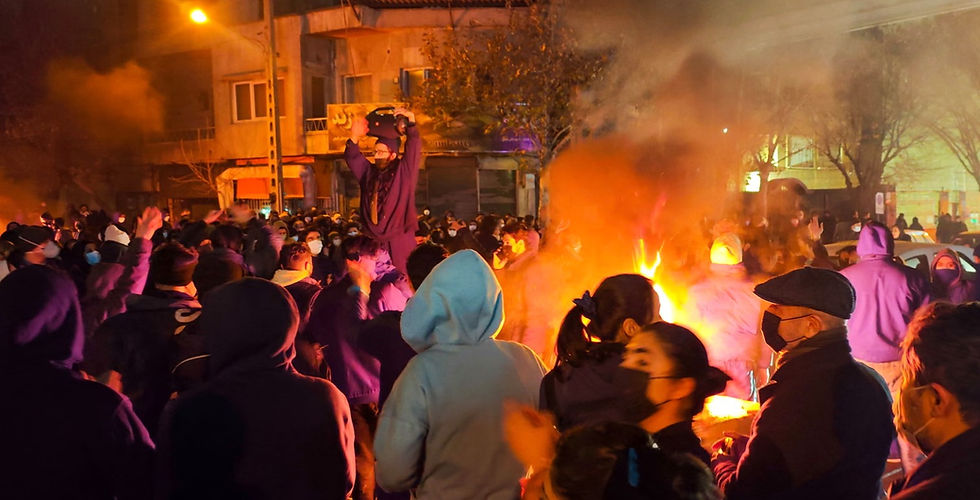
The aim, as far as we can tell, has not been to overthrow the clerical regime and entirely incapacitate the Islamic state and the IRGC. Such a goal, without boots on the ground, would be almost impossible. Even then, as the Iraq war demonstrated, replacing such a regime out of the ensuing chaos would threaten even greater instability.
The logic of this war and the manner of its prosecution points to the goal of turning Iran into a regional invalid, one that would be beholden to Western imperialism for its future prospects. If the rumours about Trump’s 15-point peace plan are to be believed, the aim is to entirely dismantle Iran’s nuclear energy infrastructure and force it to hobble along using oil and gas which would otherwise be central to its export revenue. [2]
Disabling the Iranian economy in this way would naturally open it up to US capital and help reinforce US hegemony in the region, thereby enhancing its global position vis-a- vis Chinese imperialism.
The course of the war itself has shown that this goal is far from being achieved. Whatever regime emerges from the debris of war, it will inevitably be a weaker servant of Iranian capitalism. As such, it could well open the door for the Iranian masses to once again take centre stage in history. In Part Two of this article, we will examine the class forces at work in Iran today and the prospects for an authentic revolution by the working class and peasantry as the only way out of the crisis.
Footnotes
To understand this more read the following article: https://www.blakdwarf.org/post/the-empire-strikes-back-johnson-government-turbo-charges-rearmament .
Even despite Western sanctions, oil exports alone generated about $67 billion in 2025, accountinf for around 70% of Iran’s export revenues.
The second and final part of this article will look at the internal oppoistion represented by the National Council of Resistance.
Part two of this series, Towards a New Revolution in Iran, will appear shortly. Subscribe now to be sure of getting it.


Comments