


Our Daily Bread: Hunger and Greed in Corporate Britain
Updated: Jun 7
Measured by both GDP as well as banking assets and liabilities, British capitalism is the 6th largest economy in the world. At the same time it also boasts the ninth highest level of income inequality, with a record number of 177 billionaires living in the lap of luxury whilst nearly four million workers face destitution.

One expression of this is the alarming rate of child poverty and food insecurity. According to data and reports from the government and specialist charities, roughly 2 million children live in “food insecure” households, where families are forced to skip meals, eat smaller portions or buy the least nutritious food.
Around half that number live in households that rely on handouts from food banks. This is part of a broader metric in which roughly 3 in 10 children are currently living in relative poverty and where families face the constant choice between eating or heating.
As MPs fatten themselves on gourmet meals heavily subsidised by a bloated parliamentary budget, these Right Honourable Ladies and Gentleman seem content to turn their heads away when the sight of food poverty amongst the masses is staring them directly in the face.

Whether Labour, Tory or Liberal Democrat, these institutional fat cats are like the proverbial three monkeys, save that they feel no hunger either.
Supermarkets and price controls
Following the drubbing it received in recent local elections, the Starmer administration felt it had to do something to address an issue that has become central to a cost-of-living crisis that had helped drive millions of people into the arms the ultra-rightist Reform party.
They duly performed a kite-flying suggestion that the giant supermarket chains enter into a voluntary agreement to cap or freeze prices on staple foods. Not that this would even scratch the surface of food deprivation, but at least it might forestall further price increases. However, even this extremely modest proposal was met with a storm of protest. The outrage expressed by the retail giants was echoed by Tory Party leaders who described it as a “neo-Soviet” style state intervention into a free market economy.
The proposal barely survived a day before Labour backtracked completely. Appearing on the TV Channel 4, the Minister of State for Trade, Sir Christopher Bryant, did his utmost to agree with all concerned that the supermarkets’ profit margins were already far too narrow. His trademark obsequiousness rapidly became the fashion of the day, as one Labour minister after another followed suit and joined in the common refrain : only competition in the market can regulate prices.
Profits and profit margins
It is certainly true that, compared to the mega-rich pharmaceutical, oil, banking and tech companies, the retail market’s profit margins are much smaller. Even the top supermarket, Tesco, has a profit margin of between 1-3% compared, to say, the UK-based pharma multinational , AstraZeneca, with a somewhat more bountiful return of 25-35%.
In the land of monopoly capital, Tesco certainly appears to be a bit of a pigmy. However, in the retail sector as a whole, Texaco stands head and shoulders above all others.. Regardless of Bryant's protestatiions, this is a huge corpporation that profits handsomely enough to reward its institutional shareholders and management team with mouth watering dividends and blood-warm bonuses.
As it trampled mercilessly over smaller high street and neighbourhood concerns, Tesco profits for last year (2024-25) amounted to some £3.5 billion, yielding dividends ranging from £22 milllion to £73million to institutional holdings such as HSBC Global Asset Management, Massachusetts Financial Services Company and Blackrock Inc.
As a reward for this profiteering, Tesco’s Chief Executive, Ken Murphy, received huge bonuses which, on top of his salary, provided a tidy annual sum of £10.8 million.
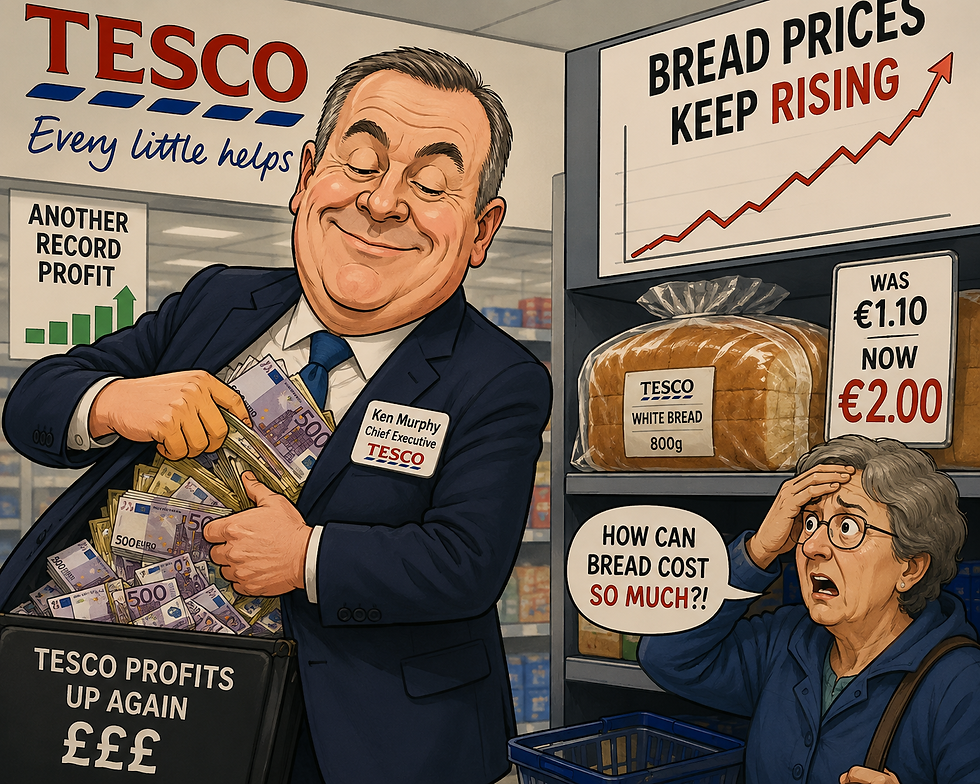
Whilst Labour spokesmen lamented Tesco's narrow profit margins, the General Secretary of the Unite union, Sharon Graham, looked at it from a different angle:
“Every day people are on their knees and being kicked while they are down. This is profiteering pure and simple. Tesco made £3.1bn profit last year and its sheer size means that the game is rigged from the start. It is obscene. Where is the off button?
“Tesco’s dominance means it can squeeze suppliers while boosting its own profits. This then feeds into more food inflation and worsens the cost of living crisis for workers and communities.”
Graham is wrong, however, to see the retail sector’s profiteering as the primary source of food inflation. The latter is just one part of a huge supply chain layered by profiteering at every level, whether that be in storage, packaging, transport or in the production and supply of the food from source.
Our daily bread
Like almost everything else in capitalist society, food is first and foremost a commodity to be bought and sold on the market. This function applies to our most staple foods and especially so to bread whose price has risen by nearly 40 percent in the last 10 years. The prices are not determined by the retail market. Rather, they arise from the cost of producing, supplying and trading wheat in a fiercely competitive market where big business and landed interests condition both costs and prices.
Of the total consumption of wheat in the UK only 20 per cent is provided by imports, mostly from the EU. The remainder is produced on land leased to farmers by huge landowners such as The Royal Estate and The Church Commissioners. The latter manages an investment fund valued at £11 billion on behalf of the Church of England. Neither of them farm directly, but they are among the largest owners of agricultural land in the UK, leasing thousands of acres to primary wheat growers.

In total, the Crown Estate leases 121,000 acres of agricultural land, with the Church Commisioners following in second place with between 80,000- 90,000 acres. Substantial parts of both these estates are used for wheat production.
From the very outset, therefore, the parasitical function of Church and Crown adds substantially to the cost of our daily bread.
While individual farmers grow the crop, a few giant corporate entities control the massive estate farming, grain trading, and milling sectors in the UK. Agribusinesses like Greenshields with 8,000 acres of arable land in Scotland, Elveden with its 22.500 acre estate bordering Norfolk and Suffolk, and the Grosvenor Group (owned by the Duke of Westminster) with its 140,000 acres of farmland and woodland, are amongst the principal beneficiaries of UK wheat and grain production.
One of the biggest hitters across the entire supply chain is the company, Frontier Agriculture, which accounted for 3.7 million metric tonnes of all grain traded in 2025. Founded as a joint venture between Associated British Foods (ASB) and Cargill Inc, its dominant market position is contingent on services ranging from seed provision, grain storage, marketing and logistics. Registering an operating profit of £37 million for 2024, it paid out £26 million in dividends, primarily to the owners of its parent companies, ASB and Cargill. The latter is one of the top 3 global agricultural traders, which by itself registered an operating profit of around £4 billion in the same financial year.
As with the spike in oil prices associated with the war on Iran, the mainstream media blamed the rise in wheat prices on the Russian invasion of Ukraine. Since Ukraine was no longer in a position to freely export its grains, it was automatically assumed that this was behind the sharp rise in bread prices. There is some truth to this in the sense that capitalist market economics are predicated on supply and demand quotas. For those who profit from commodity production, any shortfall in supply invariably leads to higher prices.
The shortfall in global exports caused by the invasion amounted to around 7m tonnes – less than 1% of the global crop. Yet the price spiked by at least 50%. In the UK, which is almost entirely self-sufficient in wheat production, supermarket bread prices rose by 15-30% between 2022 and 2024,. The root cause of this was not lower than normal yields or blockages in the supply chain. Rather, it was the horse-trading that goes on in both in UK and global financial markets where institutional investors, known as hedge funds, gamble on future trading contracts.

The bumper profits to be made out of this financial jiggery-pokery were registered in an estimated $1.9billion made from trading on food prices at the start of the war. This was explained as follows by the journal Unearthed:
“Data compiled by Société Générale suggests that food commodity trades became a key driver of Trend Index profits ahead of the Ukraine invasion, as they bought into steeply rising grain prices. In the first three months of 2022, this group of hedge funds made estimated returns of $1.9bn on wheat, corn and soybean trades, after a period of years in which they had largely made losses on these food commodities in the same three-month period.
“They were among many financial institutions that made bumper profits from the steep rise in food prices last spring. Prior to Moscow’s February 2022 invasion, Russia and Ukraine were the source of a third of the world’s wheat exports. By early March 2022, wheat futures prices – contracts to buy bushels of wheat at a price on a set date – had jumped 50% in a month, reaching their highest price in 14 years.”
Profiteering from futures trading in foods is not a new feature of contemporary capitalism. At least as early as the late 19th century, speculative contract bidding was commonplace for other staple commodities such as rice, coffee, tobacco, and sugar.
Today, this horsetrading is at the center of both the production and supply of foods, and in setting prices that put many staples increasingly out of reach for the poorer sections of the working class. Even leaving aside the highly lucrative retail sector, eliminating that profit motive in the first stages of the supply chain would obviously slash prices and drive up consumption of healthier foods. But this is not something that any of the main parties and media pundits are even prepared to talk about, far less act on.


Comments